Thick hair is often treated as the easy case for hair sticks. There is plenty of hair to wrap and plenty for the stick to grip. In practice it brings its own problems. The bun comes out wider than the stick is long. The stick meets a wall of hair halfway across and won’t go further. And by mid-afternoon a heavy coil can slide down the back of the head or leave the scalp aching.
The hairstyles below were chosen because they deal with those problems directly: they reduce bulk, divide the weight, or give the stick a clearer path through the hair. After them you’ll find how to choose a pin that is long and sturdy enough, how to keep a heavy bun comfortable, and the mistakes that most often undo a thick-hair style.
If you are new to hair sticks altogether, the basic insertion method is covered in our guide on how to wear a Chinese hair stick properly. This article builds on it.
First, Which Kind of Thick Hair Do You Have?
“Thick” is used for two different things, and they behave differently with a hair pin.
High density means many strands growing close together. Even if each strand is fine, the total volume is large, so the finished bun is big and the stick has a long way to travel.
Coarse strands means each individual hair has a wide diameter. Coarse hair usually grips a stick well and holds its shape, but it can feel stiff when you coil it and may spring out of a twist that isn’t firm enough.
Many people have both. Some have dense hair made of fine strands, which is bulky and slippery at the same time. If that sounds like your hair, the advice here on bun size and weight still applies, but you’ll also benefit from the grip techniques in how to use hair sticks in fine, slippery hair.
Length changes the picture too. Thick hair at shoulder length tends to fight back: the ends are short and stiff, so they pop out of the coil. Thick hair at waist length is more about weight. Keep your own combination in mind as you choose a style.
What Changes When Your Hair Is Thick
Most thick-hair difficulties come down to a handful of causes.
| What you notice | What’s usually happening | What helps |
|---|---|---|
| The stick won’t come out the other side | The bun is wider than the usable shaft | A longer stick, a flatter bun, or splitting the hair into two buns |
| The stick stops halfway and won’t push through | The coil is too dense to find a path | Twist into a tighter rope, adjust the angle, never force it |
| The bun slides down during the day | Weight pulls downward and the stick isn’t anchored to scalp hair | Anchor properly, place the bun lower, or cross two sticks |
| The scalp aches after an hour or two | Weight is concentrated at one point, often on a tight base | A lower bun, a looser base, or a half-up style |
| Ends and layers escape | Bulk resists wrapping neatly | Braid before coiling, tuck the ends under |
| The pin bends or feels flimsy | A slender shaft is carrying a heavy load | A sturdier working stick, with decorative pins as accents |
For a bun that slowly drops rather than falling out, see how to stop a hair stick bun from sagging.
Before You Start
A few minutes of preparation matters more with thick hair than with any other type.
Detangle completely. Knots hidden inside a dense bun become lumps the stick catches on, and they make removal painful.
Make sure your hair is fully dry. Thick hair can stay damp at the core long after the surface feels dry. A bun built on damp hair is heavier and stays damp for hours.
Twist firmer than you think you need to. Compressing the hair into a tight rope before you coil it gives you a smaller, denser bun that a stick can actually cross.
Decide how much hair really needs to go up. Not every look needs all of your hair in one bun. Several styles below deliberately leave part of it down.
Keep a soft hair tie nearby. On heavy hair, a hidden elastic under the bun takes load off the stick. It isn’t cheating; it’s what lets the pin sit comfortably for a full day.
7 Chinese Hair Pin Hairstyles for Thick Hair
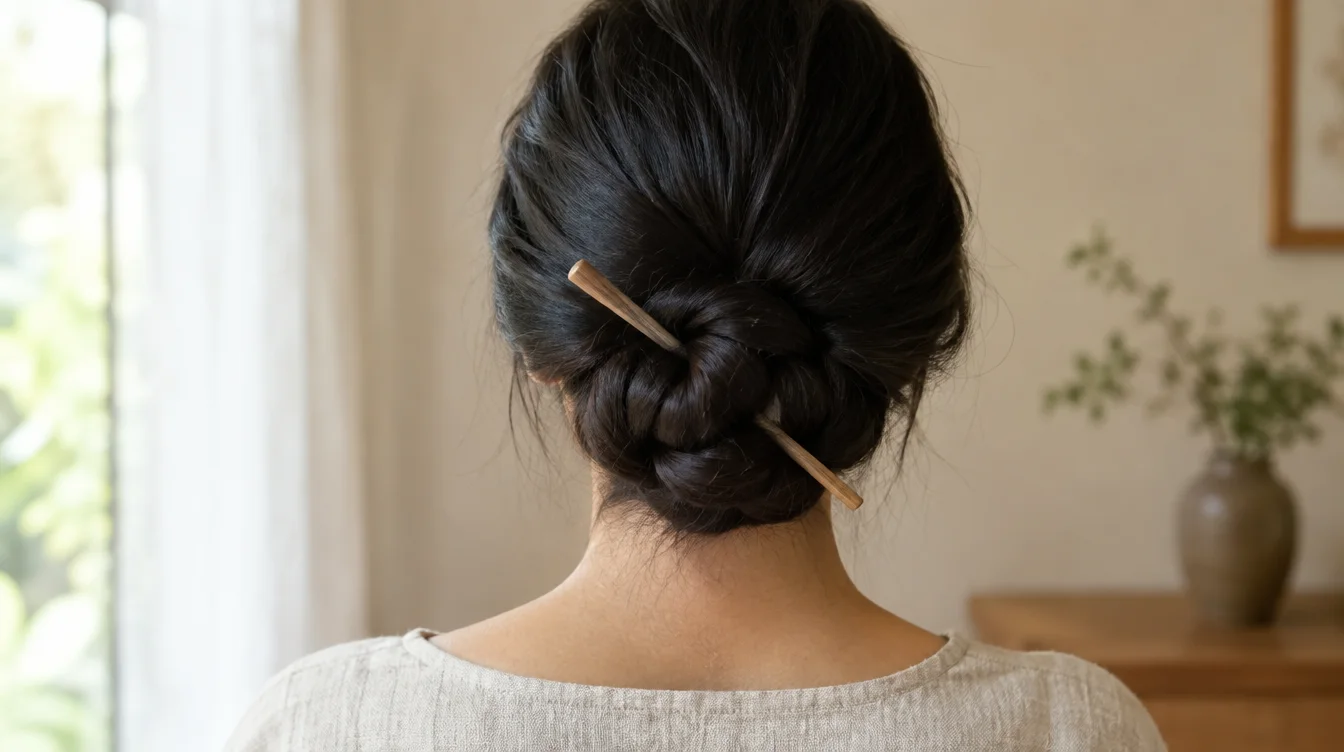
1. Low Twisted Bun with a Long Stick
Why it works: This is the most basic hair-stick style, and placing it low means the weight rests near the nape instead of hanging from the crown.
How to create it:
- Gather your hair at the nape, where a low ponytail would sit. Don’t use an elastic yet.
- Twist the full length firmly in one direction until it forms a tight rope.
- Coil the rope around its own base, keeping the coil flat against your head rather than building it outward.
- Tuck the ends under the coil.
- Insert the stick at the top edge of the bun, catch a little hair at the scalp underneath, then turn the stick and push it across the full width of the bun.
Check: if the tip doesn’t come out on the far side, the stick is too short for this bun. Re-twist tighter, try style 3, or use a longer stick.
2. Braided Low Bun
Why it works: Braiding compresses thick hair into a narrower rope, locks the ends in place, and gives the stick a textured surface to grip.
How to create it:
- Make a low ponytail. On very heavy hair, secure it with a soft elastic.
- Braid the ponytail to the end and fasten the tip with a small elastic.
- Wrap the braid around the base of the ponytail, keeping it close to the head.
- Tuck the end of the braid underneath.
- Insert the stick through the braid coil and the base, catching scalp hair as you go. Add one or two bobby pins along the lower edge if the coil feels loose.
A braided bun looks larger than a twisted one made from the same hair. If size is the problem, braid more tightly or use a three-strand braid rather than a fishtail.
3. Two Low Buns
Why it works: Splitting the hair in half makes each bun narrower, so each one can be crossed by a shorter stick, and the weight is spread across two points instead of one. This is one of the most comfortable options for very thick, long hair.
How to create it:
- Part your hair down the center of the back of your head.
- Clip one half out of the way.
- Twist the other half and coil it into a bun low behind the ear.
- Secure it with one stick, anchored to scalp hair.
- Repeat on the other side.
A matching pair of pins gives this a balanced, Hanfu-inspired look, while two plain wooden sticks keep it casual.
4. Half-Up Crown Bun
Why it works: Only the top section carries any weight, and the rest of your hair falls naturally. It’s the lightest option on this list and a good choice when a full bun gives you a headache. It also shows off length.
How to create it:
- Take a section from temple to temple, back toward the crown.
- Twist it firmly and coil it into a small bun at the crown.
- Insert the stick through the bun and a little of the hair beneath it.
- Leave the rest of your hair down, or add a lighter decorative pin beside the bun.
With very dense hair, take a narrower section than feels natural. A small, firm crown bun holds better than a large, soft one.
5. French Twist with a Hair Stick
Why it works: The vertical shape spreads thick hair along the back of the head instead of gathering it into one round coil. A stick placed across the fold anchors through several layers at once.
How to create it:
- Gather your hair as if for a low ponytail.
- Twist it upward and fold it against the back of your head.
- Tuck the ends into the fold.
- Insert the stick from one side, roughly horizontal and just below the top of the fold, catching scalp hair, and push it through.
- Secure the vertical seam with bobby pins if needed.
If your hair is very long, fold the lower length up before you twist. Otherwise the twist can become too bulky to sit flat.
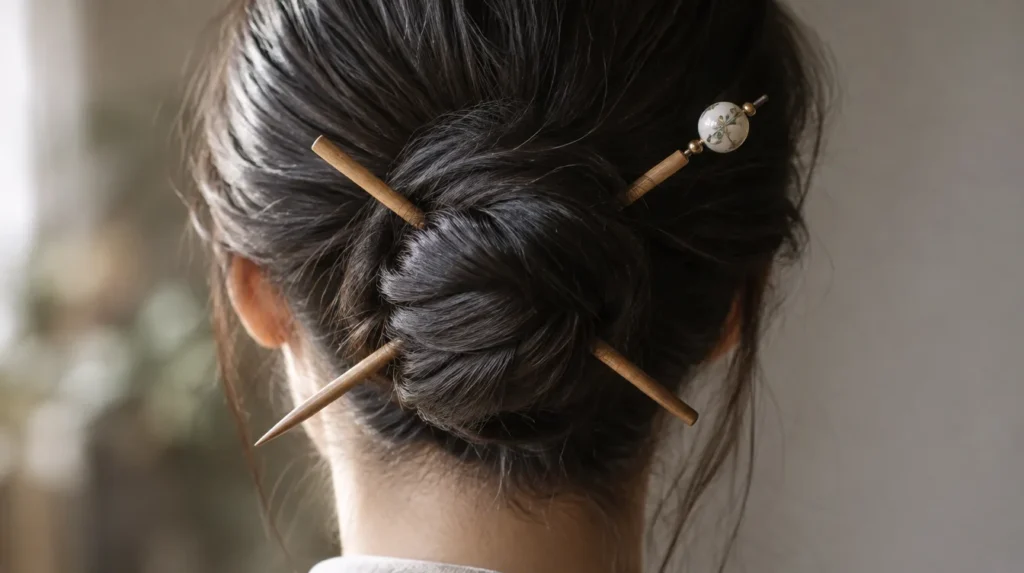
6. Crossed-Stick Bun
Why it works: Two sticks crossed in an X share the load. This is often more secure than a single stick when the hair is heavy or very long.
How to create it:
- Build a low or mid-height bun using style 1 or 2.
- Insert the first stick diagonally, from the upper left of the bun toward the lower right, anchored to scalp hair.
- Insert the second from the upper right toward the lower left, crossing the first.
- Nod and turn your head. If the bun shifts, reposition the second stick to catch more hair at the base.
A practical combination is one plain working stick and one decorative pin. The plain one does most of the holding.
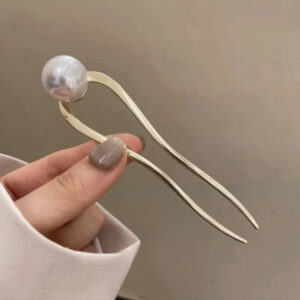
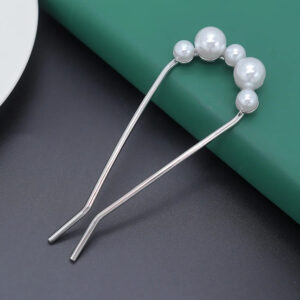
7. Low Chignon with a Two-Pronged Hair Fork
Why it works: Two prongs hold a wider area than a single point, which spreads pressure across a heavy bun. You can read more about forks and other shapes in our guide to the types of Chinese hair pins.
How to create it:
- Twist and coil your hair into a low, fairly flat chignon.
- Slide the prongs in at the top edge of the bun, close to the scalp, so they catch a little underlying hair.
- Rotate the fork so it lies flat against the bun, then push it through.
- Check that both prongs have come out on the far side.
On thick hair, the prongs need to be long enough to cross the whole chignon. If the fork resists, loosen the bun slightly rather than forcing it.
A Note on Thick Hair and Hanfu-Inspired Styles
Many modern Hanfu hairstyle tutorials add volume with hair pads, wiglets, or extensions. With thick hair you can often create that fullness from your own hair, so the work shifts from building volume to keeping it light and secure. Split buns and half-up styles are easy places to start. For more ideas, see our Hanfu hairstyles for beginners.
How to Choose a Chinese Hair Pin for Thick Hair
Measure your bun, not your hair
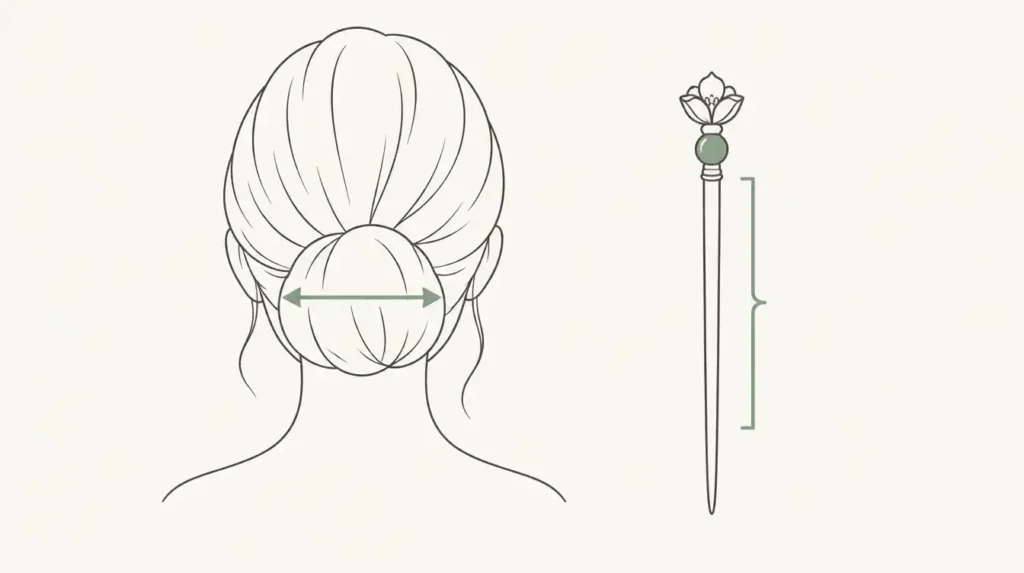
What matters is the usable length: the part of the shaft below any decorative head. It needs to be longer than your bun is wide, with a little extra so the tip clearly comes out on the other side.
The simplest way to find your number is to build your usual bun and measure across it. If your bun is about 10 cm wide, look for a usable length of roughly 13 to 15 cm. When buying, check whether a listed length includes the decorative top, because that part does no holding.
For more on choosing pins for length rather than thickness, see Chinese hair pins for long hair.
Choose a sturdy shaft
Very slender or delicate shafts can flex or bend under a heavy bun. A slightly thicker shaft pushes through dense hair with less bending, though it takes up more room inside the bun. Look at how a piece is actually made rather than judging from a photo.
Look for a gentle taper
A shaft that narrows gradually to a rounded tip finds its way through dense hair without snagging. Avoid sharp tips, which can scrape the scalp, and chipped or rough ends, which catch on strands.
Think about surface
Coarse thick hair grips most surfaces well, so smooth or polished pins are usually fine. If your hair is dense but fine, a matte or lightly textured finish will hold better.
Keep decoration in proportion
A heavy bun and a heavy, dangling ornament add up. Let a plain, sturdy stick do the holding and wear a lighter decorative pin as an accent.
Consider a pair
For heavy or very long hair, two sticks or a two-pronged fork are often more reliable than a single pin.
Keeping a Heavy Bun Comfortable
Thick hair is heavy, and how that weight sits on the head matters.
- Place the bun lower. A bun at the crown hangs from the roots there. A bun at the nape rests partly against the neck.
- Keep the base snug, not tight. Constant tension at the roots is uncomfortable, and repeatedly wearing tight styles can contribute to traction alopecia, a form of hair loss caused by ongoing pulling.
- Vary the position. Moving the bun slightly from day to day avoids stressing the same area.
- Take it down if it aches. Switching to a half-up style for the rest of the day is a reasonable fix.
- See a dermatologist if you notice persistent tenderness, broken hairs, or thinning along the hairline or part.
Removal deserves the same care. Dense hair can wrap around a stick during the day, so ease it out slowly rather than pulling. Our guide on how to remove a hair stick without pulling hair walks through it step by step.
Common Mistakes with Thick Hair
Forcing the stick through. If it stops, back it out, loosen or re-twist the bun, and try a different angle. Forcing breaks strands and can bend the pin.
Piling everything at the crown. A high, full bun is the heaviest way to wear thick hair. Start lower.
Using a short everyday stick for a large bun. If the tip doesn’t emerge, the stick can’t hold properly, however tight the bun is.
Letting a decorative pin carry the whole bun. Ornamental pins are often more delicate than plain working sticks. Use them as accents.
Over-tightening to compensate for weight. A tighter base doesn’t make a heavy bun lighter. It only adds tension.
Skipping the scalp anchor. A heavy bun held only by the coil will slide. The stick needs to catch some hair at the scalp.
Where to Start
If you’re trying a hair pin with thick hair for the first time, start with the half-up crown bun. It’s light, forgiving, and shows you how your hair responds to a stick. Move on to the low twisted bun once you know your stick is long enough, and keep two low buns or crossed sticks in reserve for days when your hair feels heaviest.
11. FAQ
Are Chinese hair pins good for thick hair? Yes, often. Thick hair, especially coarse hair, tends to grip a stick well. The challenges are size and weight, so the stick has to be long enough and the bun shaped so the weight sits comfortably.
What length hair stick do I need for thick hair? Measure the bun you usually make. The usable shaft, not counting the decorative top, should be longer than the bun is wide, with a little extra so the tip comes out on the other side.
Why can’t I push my hair stick all the way through my bun? The bun is usually too wide or too dense. Re-twist it into a tighter rope, adjust the angle, or split your hair into two smaller buns. If none of that works, the stick is too short.
Can one hair stick hold thick hair? For medium-length thick hair, often yes, especially with a firm twist and a good scalp anchor. For very heavy or very long hair, two crossed sticks, a two-pronged fork, or a hidden elastic under the bun is usually more reliable.
What is the easiest Chinese hair pin hairstyle for thick hair? The half-up crown bun. It uses only part of your hair, so it’s light, quick, and easy to adjust.
Why does my head hurt when I wear a hair stick bun? Usually because the weight is concentrated high on the head or the base is too tight. Try a lower bun, a looser base, or a half-up style. If pain or tenderness continues, take your hair down and consider seeing a dermatologist.
Is a hair fork better than a hair stick for thick hair? A two-pronged fork spreads the hold over a wider area, which can help with heavy buns. It still needs prongs long enough to cross the whole bun, and some people find a single long stick easier to insert.